<enkindle-ai> · the free process teardown · edition 01

What's quietlycosting you hoursevery week?

A short recorded walkthrough of what's quietly costing you hours — and what I'd fix first.

I look at how a process or tool actually runs. Then I record what I'd fix or automate, in order. I run my own automations and my own store, so you get an operator and a developer, not a theorist.

  • $0

    to have it made

  • 0

    calls to sit through

  • 1

    person doing the work

  • 2–3

    business days to your inbox

  1. The process, in three steps

    Your pain point

    You send the thing that's eating your time, or your store link.

  2. The walkthrough

    I record the teardown and send it back — no call, no obligation. You get a short recording of me going through your process or your store, saying plainly what I'd change and why. You also get the one or two things I'd do first, and what they're worth doing before anything else.

  3. No catch worth hiding

    You decide whether I build it. If you want the fix built, I build it. The teardown is yours regardless — it's how I win work without cold-pitching.

You're not the experiment.My own business was.

I don't sell anything I haven't run on my own business first. No clients yet, no testimonial wall — so here's the actual work instead.

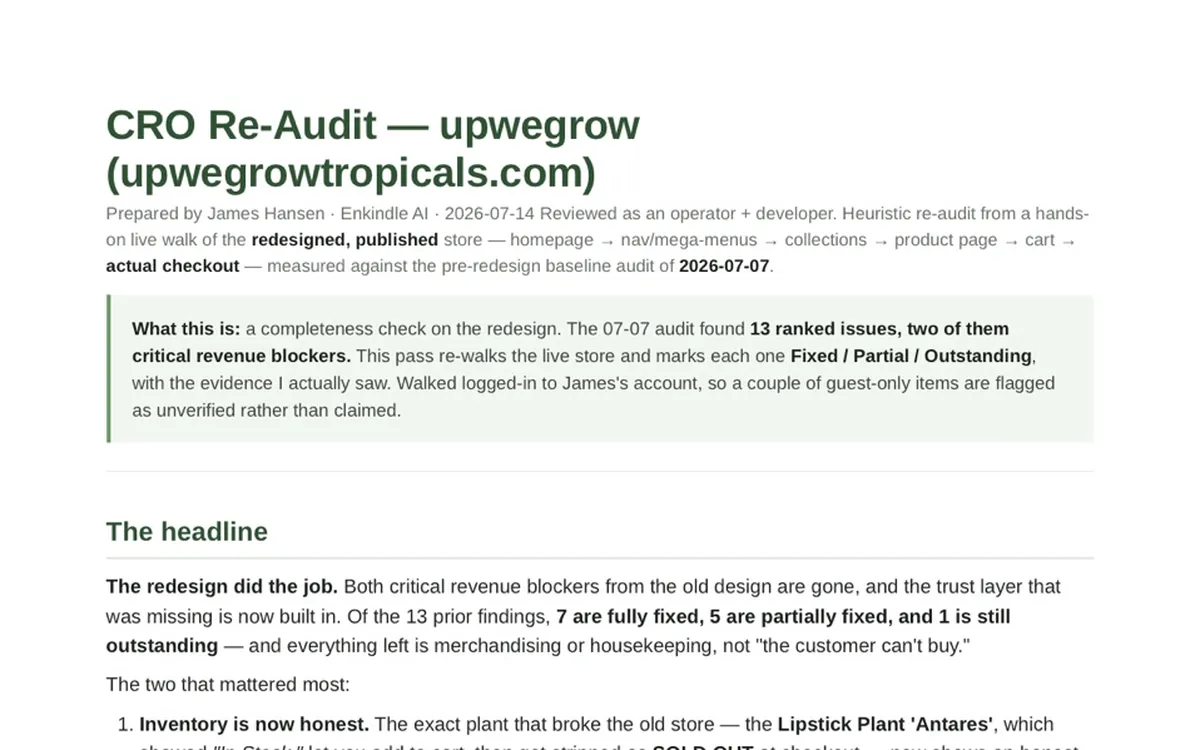
  • The top of the conversion re-audit document for upwegrowtropicals.com, prepared by James Hansen and dated 2026-07-14: a summary box noting the earlier audit found 13 ranked issues, two of them critical revenue blockers, above the start of the headline findings.
    A sample audit of my own store — the exact output you'd get. Read the full teardown
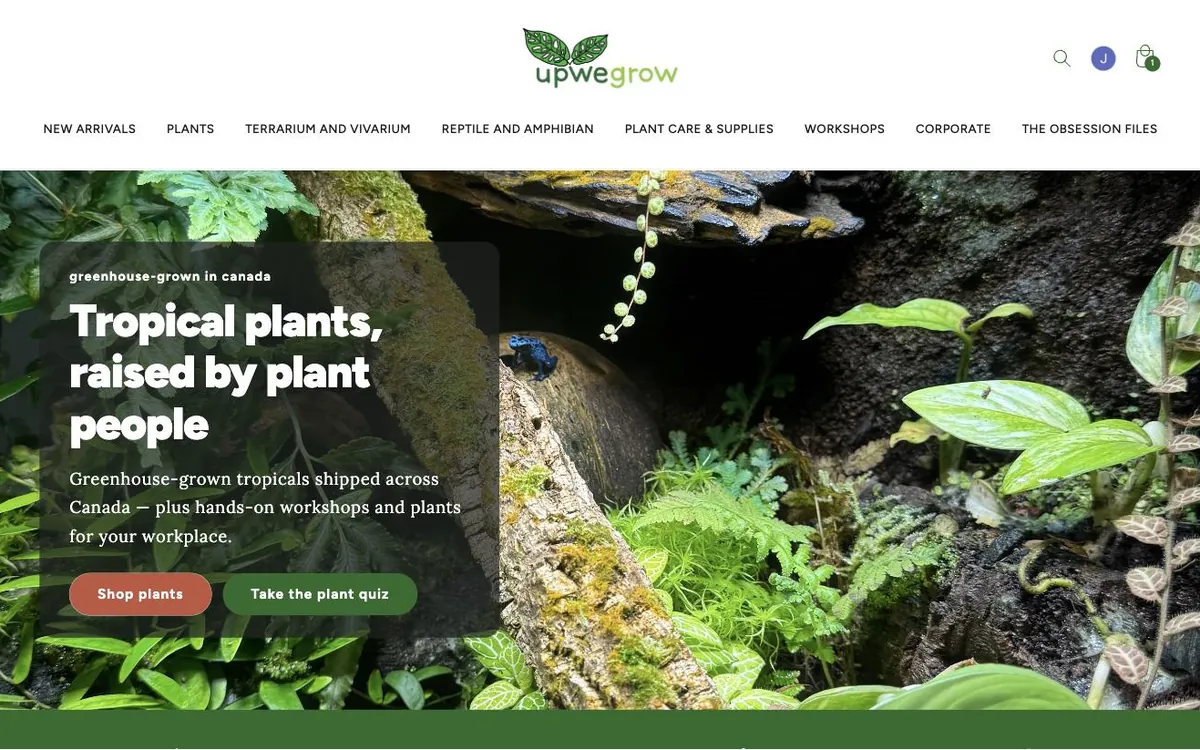
  • The redesigned Upwegrow Tropicals storefront homepage: full category navigation, a headline reading Tropical plants, raised by plant people, and a Shop plants button.
    The storefront redesign I ran on my own store — the conversion thinking behind every build.
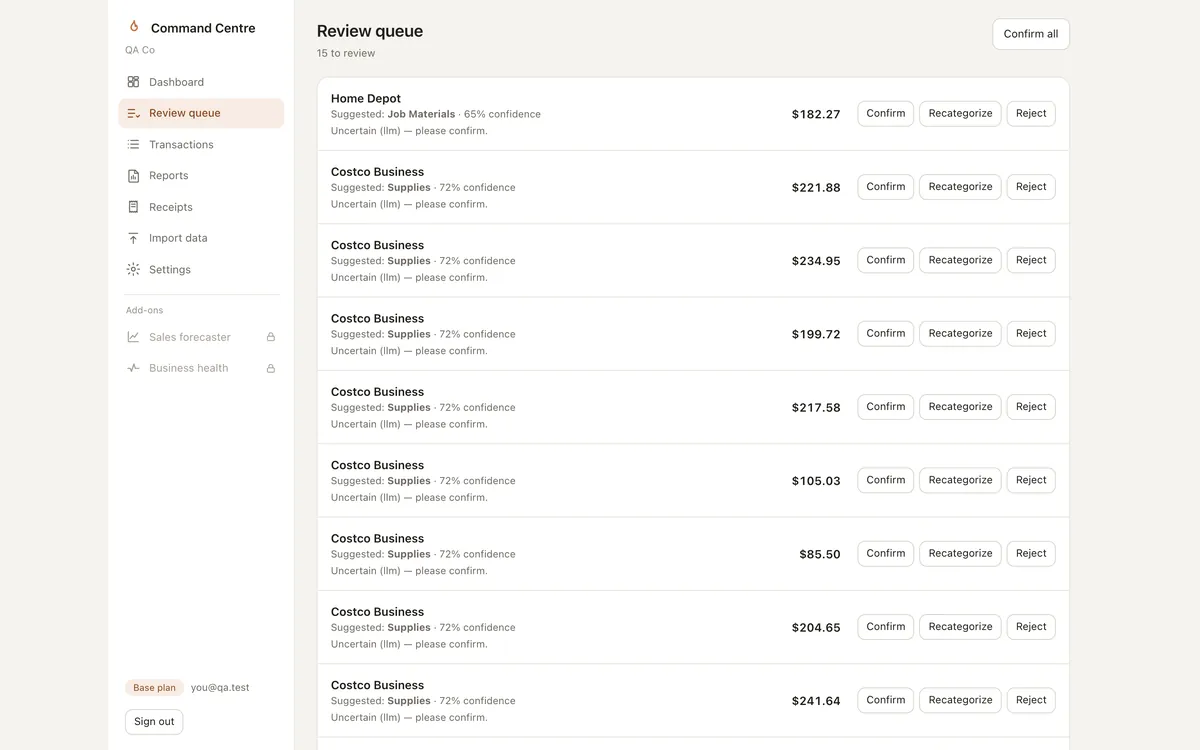
  • The Command Centre review queue, signed in to the QA demo company: fifteen transactions the Bookkeeper categorised but flagged as uncertain, each row showing the vendor, the suggested category with a confidence percentage, the amount, and Confirm, Recategorize and Reject buttons — the human check the automation hands back.
    The bookkeeping automation I built for my own books — reconciling, handled without me.

If you want the fix built

Automation builds and custom apps

I build the automation, tool, or custom app that takes repetitive work off your plate. No fixed package — it's scoped to the specific process the teardown finds, never sold as a template.

Scopedquoted after the teardown

The full conversion audit

Every step from homepage to checkout, a written fix list ranked by revenue impact, a search-and-AI pass, and a re-check 30 days later scoring what got fixed.

From $500price before I start

Search and AI visibility

Buyers now ask ChatGPT, Perplexity, and Google as much as they browse. I check the markup, content, and signals these systems read, and say plainly where the gaps are. Not a ranking promise.

Includedsame pass as the audit

Who runs Enkindle AI

Enkindle AI is a one-person AI automation and e-commerce consultancy in Edmonton, Alberta, run by James Hansen. I build automations, custom apps, and conversion audits for small businesses.

I'm James Hansen, and Enkindle is me — one person, not an agency with a stock-photo team.

I've spent years in software and in running the day-to-day of a small business, which is a rarer pairing than it sounds: most people who can build the tool can't read a P&L, and most who run the business can't build the tool. I do both, which is why I can look at your process and see the fix and what it's worth at the same time.

I started Enkindle because small operators keep paying for automation they don't need and missing the automation they do. What you get is the person doing the work — not an account manager relaying it.

Questions about teardowns, builds and pricing

What exactly do I get from a paid automation or app build?

Whatever removes the specific work that's costing you — there's no fixed package. It might be an automation wired between tools you already use, or a custom app built for a job nothing off-the-shelf does. I scope it to the process the free teardown uncovers, so you're not paying for extras you won't use.

What does the free process teardown include, and what's the catch?

A short recorded walkthrough where I look at how your process runs and tell you what I'd fix or automate first — free, no call. The catch is simple: it's how I win work without cold-pitching. If it's useful and you want the fix built, I build it. If not, you keep the teardown.

How much does a build cost, and what moves the price?

It's scoped per build, so I quote it after the teardown, never before. The price moves on two things: how complex the process is and how many tools it has to connect. A single automation between two apps sits at one end; a custom app with several integrations sits at the other.

How long does a build take?

It depends on scope. A small automation is usually days, not weeks; a custom app with several moving parts takes longer. You'll get a real timeline with the quote, once the teardown shows what the work involves — not a guess up front.

What does the free store teardown include, and what do I get from the paid CRO audit?

The free store teardown is a short recorded walkthrough with the first fixes I'd make. The paid audit goes the whole way: every step from homepage to checkout, a written fix list ranked by revenue impact, a search-and-AI pass, and a re-check 30 days later scoring what got fixed. Same honest catch — the free look is how I earn the paid one.

How much does the CRO audit cost, and what moves the price?

The full audit starts at $500. What moves it is the size and complexity of your store — a tight catalogue with a standard checkout is straightforward; a large store with custom pages and multiple templates takes longer to go through. You'll know the price before I start, not after.

Do you need access to my store or systems?

Less than you'd expect to start. For a store teardown I only need your public URL — I look at it the way any shopper would. For a build, I need access to the specific tools the work touches, and nothing beyond that. I ask for the minimum required, when it's required.

What platforms or tools do you work with?

Most platforms and stacks. My own store runs on Shopify, so that's where my e-commerce experience is deepest — I know where it leaks conversion because I've fixed it myself. For automation and app builds, I work with the tools you already use rather than making you switch.

Do you implement the fixes or the build, or just find and scope them?

Both, and you choose. The teardown finds and ranks the work; from there you can take the list and do it yourself, or have me build it. The CRO audit is a find-and-scope deliverable by design, though I can implement fixes too. If the gap is how you show up in AI search, I cover that in the audit too — same pass, no separate engagement.

Is there a guarantee?

Not a formal one yet — and I'd rather say that plainly than word one loosely and argue about it later. What you get instead is a free teardown before you spend anything, so you see the actual work first, and a price agreed before I start rather than after. Builds are the same: scoped and quoted up front, so you approve exactly what I'll build and what it costs before any work starts.

Why should I trust you if you haven't had clients yet?

Because you don't have to take my word for it — the free teardown shows my actual work on your actual business before you spend anything. Enkindle is new; my method isn't. It's the same process I run on my own store and my own books. I'd rather show you than ask you to trust me.

<start-here>

Hand me the thing that's eating your week.

Tell me what it is, and I'll send back a short, free teardown of what I'd fix or automate — no call, no obligation.

Get a free process teardown